
I was riding the Five-College bus on my way back to Mount Holyoke when I saw a friend from Hampshire College. "Claudia! I haven't seen you in ages," I exclaimed and hugged her. "Well, yes, that is because I just came back from Mexico," she responded. Yes, I did freak out.
My mom called me early on Sunday morning to warn me about the flu. She had heard the news in Italy, knew the symptoms and informed me about precautionary measures I needed to take. I had to take a lot of vitamins and wash my hands non-stop. I told her not to worry, hung up and went out to socialize with people.
Now that "at least two, and perhaps six, students have tested positive" for swine flu at Amherst College, I am not sure I am going to the same tomorrow. Today, the president of Amherst College released a campus-wide e-mail announcing the possible swine flu containment. "We are asking that students with compromised immune systems, serious heart, lung, kidney or liver diseases, and diabetes contact Health Services for advice regarding precautionary measures," he wrote in the email. Minutes after I read about this on 22News, I received an email from Robert Holub, the University of Massachusetts chancellor. "This remains a rapidly evolving situation and we will continue to update you as new information becomes available," he wrote.
Although the rapid spread of the flu is scary enough in itself, there is a lot more to it that adds to the student panic. With graduation coming up in May, international students won't be able to invite family and friends from Mexico to their commencement celebrations.
Moreover, there will be further complications with those who tested positive for the flu but had planned on leaving the U.S. for the summer. Infected individuals must be put under a 7-day quarantine, which will undoubtedly prompt change in their travel plans.
To all this I say, I hope my mom is not watching the news.
Thursday, April 30, 2009


Tuesday, April 28, 2009
Keep the conversation going
If you had entered my 300-level sociology seminar two days ago, you would have seen a 86-year-old African American student talking about jazz. Good Dues Blues and Shoo Shoo Baby playing in the background, Luora was presenting her final research project on jazz music in front of the class and the professor.
Studying with diverse individuals has proved to be a highly valuable experience for me. And when I say diverse, I refer not only to the students' race, ethnicity, religion or political affiliation. I also refer to their age.
Mount Holyoke College runs a program (Frances Perkins program) for women of non-traditional age. Every woman over the age of 24 can earn an undergraduate degree on a full or part-time course schedule. Each year approximately 140 diverse and intellectually curious women enroll at Mount Holyoke as Frances Perkins scholars (FPs). And I was lucky enough to have Luora, the oldest African American FP student, in my sociology class Black Cultural Production and Consumption.
"Let me tell you mine experience," Luora started answering a classmate's question about the given jazz presentation. Everyone in the classroom beamed and listened attentively. We love her stories. We love it when she makes the abstract theories about, for example, black authentic identity, real for us.
Born in 1923, Luora is not only an active participant in our class discussions but also a carrier of her generation's worldview. In the classroom, she enables a discourse between at least three generations--her Civil Rights generation, our professor's Generation X and the students' Generation Y.
"Jazz is a conversation," she said in conclusion to her presentation. "It continues a tradition of communication." Undoubtedly, having her and other FP students in my academic program also continues a tradition of communication.
Studying with diverse individuals has proved to be a highly valuable experience for me. And when I say diverse, I refer not only to the students' race, ethnicity, religion or political affiliation. I also refer to their age.
Mount Holyoke College runs a program (Frances Perkins program) for women of non-traditional age. Every woman over the age of 24 can earn an undergraduate degree on a full or part-time course schedule. Each year approximately 140 diverse and intellectually curious women enroll at Mount Holyoke as Frances Perkins scholars (FPs). And I was lucky enough to have Luora, the oldest African American FP student, in my sociology class Black Cultural Production and Consumption.
"Let me tell you mine experience," Luora started answering a classmate's question about the given jazz presentation. Everyone in the classroom beamed and listened attentively. We love her stories. We love it when she makes the abstract theories about, for example, black authentic identity, real for us.
Born in 1923, Luora is not only an active participant in our class discussions but also a carrier of her generation's worldview. In the classroom, she enables a discourse between at least three generations--her Civil Rights generation, our professor's Generation X and the students' Generation Y.
"Jazz is a conversation," she said in conclusion to her presentation. "It continues a tradition of communication." Undoubtedly, having her and other FP students in my academic program also continues a tradition of communication.
Monday, April 20, 2009
Social media and indigenous people
In today’s global society, the maintenance of cultural heritage and celebration of diversity have become especially relevant topics. In this context, new media technologies definitely contribute to the communication rights’ expansion of indigenous people.

Firstly, they allow greater access to alternative sources of information. For instance, there is a wide range of blogs dedicated to the causes of indigenous people. (Indigenous Issues Today, Ushahidi, Noongar) They offer personal perspectives about the distinct realities of many indigenous people. As a result, these blogs play an important role in raising cultural awareness and recognition.
Similar is the function of news and music podcasts for indigenous people. For instance, Michael Kickingbear, a member of the Mashantucket Pequot Tribal Nation, narrates and hosts a podcast titled Indigenous Peoples Music. This is a show that features Native American Indian artists and allows listeners to “experience traditional as well as contemporary styles of native music.”

Free and open-source projects like Wikipedia can also positively influence the expansion of indigenous people’s communication rights because they foster collaboration. By being open to constant improvement from experts as well as from the public, Wikipedia encourages valuable participation and social activity.
The Internet video portal for indigenous filmmakers Isuma TV brings positive change to the Inuit population. In addition to encouraging more independent filmmakers to tell their stories in a creative fashion, Isuma TV works on restoring “old videos whose irreplaceable cultural information is in danger of being lost forever.” Thus, it aims at reinforcing the Inuit collective memory and cultural heritage in a well-structured and widely accessible space.
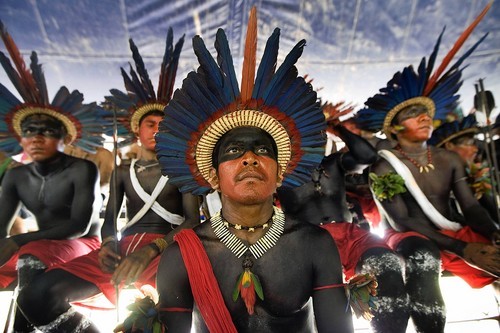
Firstly, they allow greater access to alternative sources of information. For instance, there is a wide range of blogs dedicated to the causes of indigenous people. (Indigenous Issues Today, Ushahidi, Noongar) They offer personal perspectives about the distinct realities of many indigenous people. As a result, these blogs play an important role in raising cultural awareness and recognition.
Similar is the function of news and music podcasts for indigenous people. For instance, Michael Kickingbear, a member of the Mashantucket Pequot Tribal Nation, narrates and hosts a podcast titled Indigenous Peoples Music. This is a show that features Native American Indian artists and allows listeners to “experience traditional as well as contemporary styles of native music.”

Free and open-source projects like Wikipedia can also positively influence the expansion of indigenous people’s communication rights because they foster collaboration. By being open to constant improvement from experts as well as from the public, Wikipedia encourages valuable participation and social activity.
The Internet video portal for indigenous filmmakers Isuma TV brings positive change to the Inuit population. In addition to encouraging more independent filmmakers to tell their stories in a creative fashion, Isuma TV works on restoring “old videos whose irreplaceable cultural information is in danger of being lost forever.” Thus, it aims at reinforcing the Inuit collective memory and cultural heritage in a well-structured and widely accessible space.
Subscribe to:
Posts (Atom)

 Posts
Posts

