
"Information is not air," I remember reading in an article for my New Media class this semester. I stopped reading in surprise. "What do you mean it is not air?" I thought.
Then I realized that with the abundance of free information online I tend to think of it as air. In addition to my most visited web pages, I am actively using bookmarks, RSS feeds and Google alerts to keep up with latest news and emerging trends. Information on the Web is free and necessary. It is exactly like air.
Yet some sources limit that air. A couple of days ago I found a Wallstreet Journal headline featured in my Google Alerts. The link redirected me to the WSJ page and I saw the story's lead. But to read on, I had to subscribe.
Some reliable Web sources like the WSJ and Encyclopedia Britannica require paid subscription. When I encounter such a challenge, I just close the page and look for the same information elsewhere. The chances are that I will find it on the NY Times or Wikipedia.
Information is not air because one has to be selective when choosing sources. But the choice becomes easy when one of two competing sources is free and the other one paid. So despite your high-quality content, WSJ, I guess I will have to pass.
Showing posts with label new media technologies. Show all posts
Showing posts with label new media technologies. Show all posts
Saturday, May 30, 2009


Monday, April 20, 2009
Social media and indigenous people
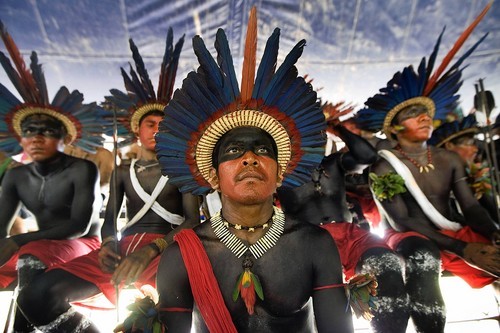
In today’s global society, the maintenance of cultural heritage and celebration of diversity have become especially relevant topics. In this context, new media technologies definitely contribute to the communication rights’ expansion of indigenous people.

Firstly, they allow greater access to alternative sources of information. For instance, there is a wide range of blogs dedicated to the causes of indigenous people. (Indigenous Issues Today, Ushahidi, Noongar) They offer personal perspectives about the distinct realities of many indigenous people. As a result, these blogs play an important role in raising cultural awareness and recognition.
Similar is the function of news and music podcasts for indigenous people. For instance, Michael Kickingbear, a member of the Mashantucket Pequot Tribal Nation, narrates and hosts a podcast titled Indigenous Peoples Music. This is a show that features Native American Indian artists and allows listeners to “experience traditional as well as contemporary styles of native music.”

Free and open-source projects like Wikipedia can also positively influence the expansion of indigenous people’s communication rights because they foster collaboration. By being open to constant improvement from experts as well as from the public, Wikipedia encourages valuable participation and social activity.
The Internet video portal for indigenous filmmakers Isuma TV brings positive change to the Inuit population. In addition to encouraging more independent filmmakers to tell their stories in a creative fashion, Isuma TV works on restoring “old videos whose irreplaceable cultural information is in danger of being lost forever.” Thus, it aims at reinforcing the Inuit collective memory and cultural heritage in a well-structured and widely accessible space.
Firstly, they allow greater access to alternative sources of information. For instance, there is a wide range of blogs dedicated to the causes of indigenous people. (Indigenous Issues Today, Ushahidi, Noongar) They offer personal perspectives about the distinct realities of many indigenous people. As a result, these blogs play an important role in raising cultural awareness and recognition.
Similar is the function of news and music podcasts for indigenous people. For instance, Michael Kickingbear, a member of the Mashantucket Pequot Tribal Nation, narrates and hosts a podcast titled Indigenous Peoples Music. This is a show that features Native American Indian artists and allows listeners to “experience traditional as well as contemporary styles of native music.”

Free and open-source projects like Wikipedia can also positively influence the expansion of indigenous people’s communication rights because they foster collaboration. By being open to constant improvement from experts as well as from the public, Wikipedia encourages valuable participation and social activity.
The Internet video portal for indigenous filmmakers Isuma TV brings positive change to the Inuit population. In addition to encouraging more independent filmmakers to tell their stories in a creative fashion, Isuma TV works on restoring “old videos whose irreplaceable cultural information is in danger of being lost forever.” Thus, it aims at reinforcing the Inuit collective memory and cultural heritage in a well-structured and widely accessible space.
Subscribe to:
Posts (Atom)

 Posts
Posts

